
 If you are in the Houston area or the Southeast Texas region and would like to learn more about our professional services, please visit our companion website at Rainwater Harvesting Houston.
| 2 Roof & Gutters |
Of Leaves |
Of Dirt |
| 4 Storage |
Tank Sizing |
Design |
Tank Types & Construction |
Placement |
Self Cleaning |
Maintenance |
| 5 Pressurization |
5.1  Muscle Power Muscle Power |
 5.3 Hand Pumps 5.3 Hand Pumps |
| 6 Purification |
What's Clean? |
Before Storing |
In Tank Purification |
Filtration |
| Low Tech Purification |
| Mid Tech Purification |
 High Tech Purification High Tech Purification |
7 About Arsenic |
| 8 Water Testing |
| 9 Maintenance |
| 10 Resource Links |
| 11 Donate |
|
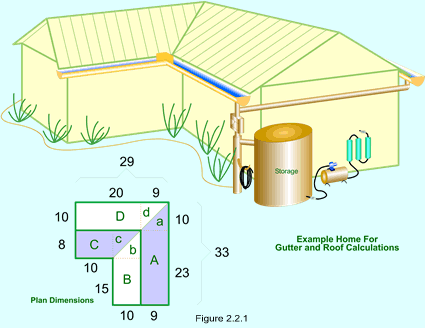 If you have anything other than a very simple roof, you will need to visually break the roof into potentially guttered areas. Figure 2.2.1 depicts a home with a valley and a hip. I am not going to distinguish between Metric or English units; the process will be the same regardless. We will use this as an example. Once you’ve got an idea of how to make the calculations, we will discuss some things you should consider when you go out and take your actual roof measurements.
 |
Area |
Calculation |
Area |
Gutter length |
|
Aa |
This is the sum of area A and a. |
252 |
33 |
|
Bb |
Area B is 10 x 15 = 150 |
190 |
15 |
|
Cc |
Area C is 8 x 10 = 80 |
120 |
10 |
|
Dd |
Area D is 10 x 20 = 200 |
245 |
29 |
|
Total possible guttered roof area = |
807 |
||
|
Longest single straight gutter length is along area Aa and equals |
33 |
||
|
Maximum connected gutter length would be to combine area Dd and Aa at the corner for a maximum total length of |
62 |
Things to consider when you go outside to measure your roof
-
If you have a tree that overhangs one of the roof sections, you might want to make a note to yourself that there might be a need to remove large quantities of leaves and twigs.
-
You may want to consider where to place your tank. We will calculate the longest distance between downspouts soon. This will probably dictate where you put your tank and which areas can be combined into a single gutter. You will need to refer back to this drawing several times to get an idea of which areas can be combined. If you get lucky, you will be able to combine the areas Dd and Aa for a total gutter length of 62, and put the tank at the corner that we have shown in figure 2.2.1. Otherwise, you might have to use two tanks. One as shown, and another at the corner of areas d and a. We will discuss this in more detail in the Gutter Sizing and Slope section. back to overview
